Buffalo Hump (Neck Hump): Why Does It Appear and Can Body Treatments Help?
If you have ever noticed a soft or dense fullness forming at the base of your neck, you are far from alone. Countless individuals search online for solutions to a “buffalo hump,” neck hump, dowager’s hump, or upper-back fat pad. The good news is that in many cases, this localized fullness can be significantly softened and reduced. The less magical news? Human bodies are remarkably stubborn. They rarely surrender to a single heroic treatment after years of building a structural issue. Biology insists on absolute consistency—inconsiderate, but entirely predictable.
What Exactly Is a Buffalo Hump?
A buffalo hump is a visible accumulation of tissue or raised fullness located between the lower neck and upper back, typically centered around the C7 vertebra. Despite popular assumption, it is rarely “just fat.” Histologically, a neck hump can be composed of multiple distinct layers:
- Localized adipose tissue deposits.
- Stagnant interstitial fluid congestion.
- Dense, restricted fibrotic connective tissue.
- Chronically bound and thickened cervical fascia.
- Overloaded, hyper-contracted deep neck and shoulder muscles.
Because several anatomical structures are simultaneously involved, effectively treating a neck hump requires a sophisticated strategy that goes far beyond simply attempting to “break down fat.”
Why Does a Neck Hump Develop?
Understanding why your body built this tissue barrier is the first step toward correcting it. Contributing factors typically include:
- Chronic Forward-Head Posture: Hours spent looking down at smartphones, laptops, and computer screens force the head forward. Over time, the upper trapezius and surrounding cervical muscles remain chronically overloaded, while local tissues stiffen and thicken to support the mechanical leverage.
- Lymphatic Stagnation: The lymphatic system is responsible for clearing metabolic waste. When microcirculation in the upper back slows down due to sustained postural tension, tissues can become swollen, dense, and immobile.
- Hormonal Fat Storage: The upper back and posterior neck are common areas for hormone-driven fat distribution, particularly in women navigating perimenopause and menopause.
- Fibrotic Tissue Remodeling: Long-term low-grade inflammation and poor tissue mobility cause soft collagen fibers to cross-link rigidly, turning soft fluid congestion into firm, fibrous tissue.
Medical Note: If a neck hump appears suddenly, grows at an unusually rapid rate, or is accompanied by other systemic symptoms, it is vital to consult your primary healthcare provider to rule out underlying endocrine conditions like Cushing’s syndrome or medication-related factors.
Can Massage and Body Treatments Help?
For the vast majority of mechanical and congestive cases, yes, professional body treatments can make a noticeable visual and physical difference. Success depends entirely on the biological composition of the hump. If the area consists primarily of fluid retention, fascial restriction, fibrosis, or localized circulation issues, targeted therapy can dramatically soften the profile.
How We Treat Buffalo Humps at TIVA BEAUTY Calgary
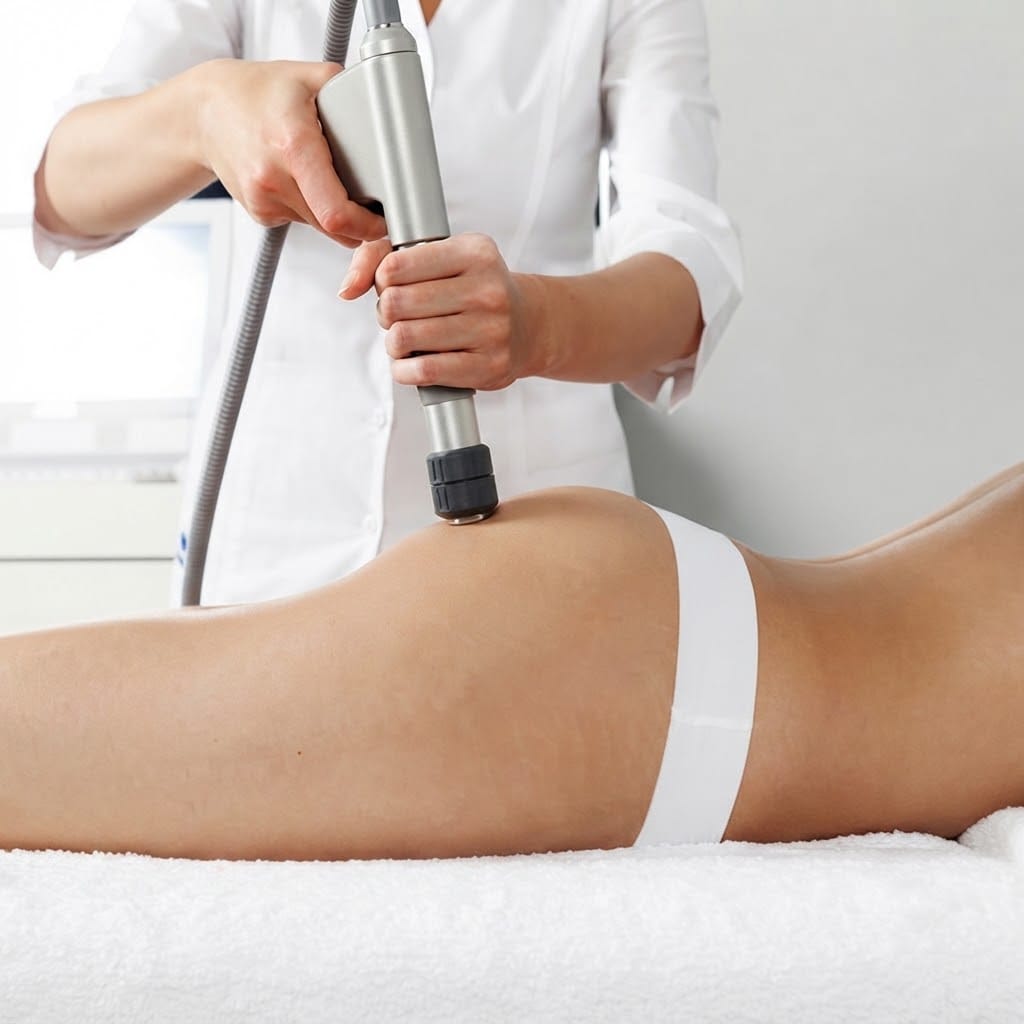
At TIVA BEAUTY in Calgary, we utilize advanced Italian ICOONE® Roboderm® technology, which combines patented multi-microstimulation with controlled mechanical vacuum action. Unlike aggressive manual massage that can bruise sensitive cervical tissues, ICOONE works by gently lifting the skin thousands of times per minute while mobilizing the deep structures underneath.
Depending on your tissue density, our customized protocols integrate:
- Precision small handpieces designed for delicate contour work around the C7 vertebra and neck.
- Broader handpieces to mobilize upper-back fascia and shoulder tissues.
- Complementary manual soft-tissue release techniques when appropriate.
- Progressive staging tailored specifically to your tissue’s response.
What to Expect: Timeline and Results
There is no honest professional who can promise that years of accumulated postural and tissue changes will vanish in a single 60-minute session. However, clients frequently report feeling an immediate sense of physical lightness through the neck and shoulders, reduced tightness, and softer tissue texture right after treatment.
Visible, structural improvement develops progressively over a series:
- Mild Congestion: Typically responds well within 4 to 6 sessions.
- Moderate Fullness: Generally requires 6 to 10 sessions.
- Dense Fibrotic Tissue: May require 10 to 15+ sessions, ideally paired with targeted posture correction and ergonomic changes.
“Good body care isn’t about chasing the latest trending machine on social media. It is about assessing your unique tissue biology and selecting the exact combination of tools required to solve the problem.”
Personalized Body Protocols in Calgary
At TIVA BEAUTY, we reject the notion of a universal body treatment menu. Whether you are dealing with a cervical neck hump, stubborn fluid retention, or post-weight-loss skin laxity, we assess your tissue first, then build a comprehensive strategy utilizing ICOONE microstimulation, professional Bioline Jatò body care, and targeted wrapping protocols.