Microneedling for Pigmentation: Does It Really Help?
Pigmentation is one of the most common reasons clients start looking for advanced facial treatments.
Sun spots, post-acne marks, uneven skin tone, and patches that seem to become darker every summer can make the complexion look less even, even when the skin itself is healthy.
Microneedling is frequently recommended for pigmentation.
But does it actually work?
The answer is: it can help certain types of pigmentation, but the protocol matters enormously.
At TIVA BEAUTY in Calgary, microneedling is approached as a controlled skin-renewal treatment rather than simply “going deeper” for a stronger result.
Why Does Pigmentation Appear?
Melanin is the pigment responsible for much of the colour in our skin.
Specialized cells called melanocytes produce melanin as part of the skin’s natural protective response.
Several factors can increase or disrupt pigment production, including:
- UV exposure
- acne and inflammation
- hormonal changes
- skin injury
- genetics
- aging and accumulated sun exposure
This means two brown spots that look similar in the mirror may have completely different causes.
And that matters when choosing a treatment.
How Does Microneedling Work?
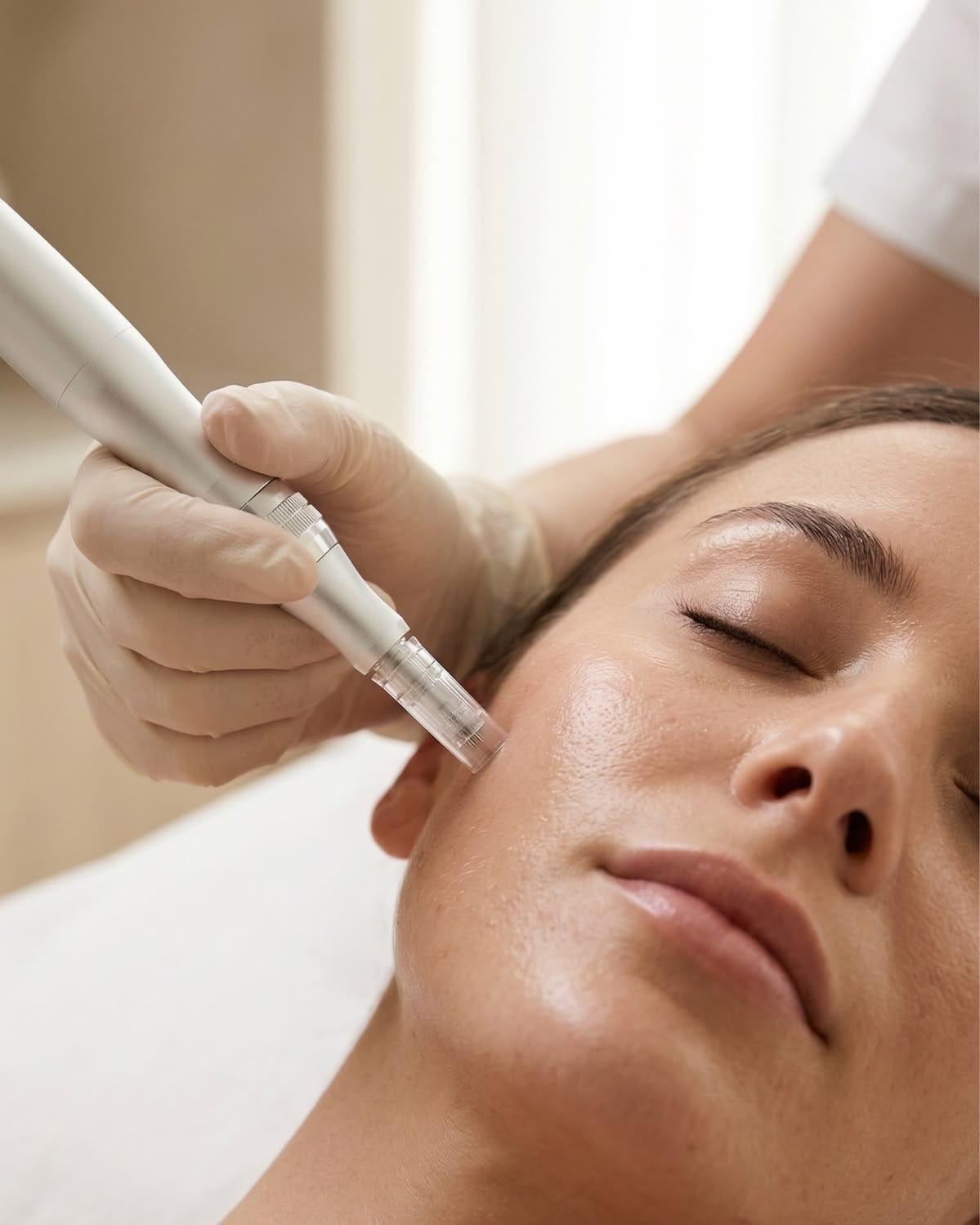
Microneedling creates thousands of controlled microscopic channels in the skin using very fine needles.
These micro-injuries initiate the skin’s natural wound-healing response.
During this process, signalling molecules are released and fibroblasts become involved in tissue repair and remodeling.
Over time, this process can support the production and remodeling of structural proteins including collagen.
This is why microneedling is commonly used to improve the appearance of:
- uneven skin texture
- enlarged-looking pores
- acne scars
- fine lines
- loss of firmness
- certain forms of uneven pigmentation
The goal isn’t to damage the skin.
The goal is to create precisely controlled stimulation followed by healthy repair.
How Can Microneedling Help Pigmentation?
Microneedling can support more even-looking skin through several mechanisms.
First, controlled skin renewal can gradually improve the appearance of superficial discoloration.
Second, microneedling is often incorporated into treatment programs alongside carefully selected professional skincare designed to target uneven tone.
And third, improving overall skin texture and quality can make pigmentation appear less visually dominant.
But pigmentation treatments should always be approached gradually.
Trying to erase every dark spot in one session is usually where sensible skincare ends and inflammation begins.
Why Do Professional Serums Matter?
Microneedling temporarily changes the skin barrier.
That means the products used during and immediately around the procedure must be selected very carefully.
Professional protocols may incorporate ingredients chosen to support hydration, recovery and a more even-looking complexion.
Depending on the skin and protocol, pigmentation-focused skincare may contain ingredients such as:
- Tranexamic acid – commonly used in pigmentation-focused cosmetic formulations.
- Niacinamide – supports the skin barrier and can help improve the appearance of uneven tone.
- Hyaluronic acid – provides hydration and supports the skin during recovery.
- Antioxidants and other brightening ingredients – selected according to the client’s skin condition and treatment plan.
More ingredients do not automatically mean a better treatment.
Immediately after microneedling, skin is temporarily more permeable, so product quality and formulation become particularly important.
Can Microneedling Make Pigmentation Worse?
Yes.
This is one of the most important things to understand before treating pigmentation.
Any procedure that creates inflammation can potentially trigger post-inflammatory hyperpigmentation (PIH) in susceptible skin.
The risk can increase with overly aggressive needling, inappropriate treatment depth, excessive treatment frequency, active sun exposure or poor aftercare.
This is why deeper isn’t automatically better.
When pigmentation is the concern, controlled treatment is far more important than creating dramatic redness for Instagram.
Microneedling for Post-Acne Pigmentation
Post-acne skin is particularly interesting because several concerns often exist simultaneously.
A client may have brown or red post-acne marks, uneven texture, enlarged-looking pores and actual depressed acne scars.
Microneedling can therefore be useful because the treatment plan can focus not only on discoloration but also on overall texture and skin remodeling.
Active inflammatory acne, however, needs to be assessed before microneedling.
What About Melasma?
Melasma requires a much more cautious approach.
Because melasma can be influenced by hormones, UV radiation, visible light, heat and inflammation, aggressive procedures may sometimes worsen it.
Microneedling may be incorporated into carefully selected melasma protocols, but it should never be presented as a simple cure.
For melasma-prone skin, controlling triggers, appropriate topical skincare and consistent sun protection are essential.
SPF Is Part of the Treatment
You can invest in excellent professional treatments and still undermine the entire pigmentation program with uncontrolled UV exposure.
After microneedling, sun protection becomes particularly important.
A broad-spectrum SPF should be used consistently, not only immediately after treatment but as part of long-term pigmentation management.
In Calgary, this matters even during colder months.
Snow, altitude and clear winter skies did not receive the memo that “peel season” has started.
Microneedling for Skin Quality, Not Just Pigmentation
One reason we like microneedling is that pigmentation doesn’t have to be the only target.
The same controlled repair process can also be used to address overall skin quality.
For clients concerned about early loss of firmness, fine lines, texture or post-acne changes, microneedling can become part of a broader skin-remodeling strategy.
This is especially relevant for women 35+ and 40+, when changes in collagen, hydration and skin elasticity become increasingly visible.
Microneedling & Pigmentation Treatments in Calgary
At TIVA BEAUTY Calgary, microneedling treatments are selected according to the condition of the skin rather than following one aggressive protocol for every face.
If pigmentation is your main concern, we first need to understand what kind of pigmentation we are looking at and how reactive your skin is.
From there, professional microneedling can be combined with appropriate pigmentation-focused skincare, hydration, LED therapy or other skin treatments when indicated.
Because successful pigmentation treatment isn’t about attacking pigment harder.
It’s about controlling inflammation, supporting skin renewal and gradually creating a clearer, more even-looking complexion.